Skip to content

Cellulosic fibers are becoming one of the more interesting material stories heading into 2027, but the conversation is changing. A few years ago, many product teams approached viscose, Modal, or Lyocell mainly as softer alternatives to conventional materials. Today, the discussion is much broader. Brands are asking where the cellulose comes from, how it is processed, whether the feedstock can be traced, whether recycled inputs are genuinely available at commercial scale, how the fabric behaves after washing, and whether the material can support the intended retail price.
For womenswear, that change is particularly important because cellulosic fibers are closely connected with qualities customers can actually feel: softness, fluid movement, breathability, comfort, and a refined surface. Yet a fiber trend only becomes commercially useful when those qualities survive pattern development, sewing, washing, quality control, bulk production, and repeat orders. XZapparel sees the strongest opportunity in treating cellulosic materials as part of the complete garment-development process rather than as a sustainability label added at the end.
In short, the key cellulosic fiber trends for 2027 are the continued importance of viscose, stronger interest in Lyocell and Modal, more responsible feedstock sourcing, growth in recycled and next-generation cellulose, better traceability, and cellulosic-rich performance blends. The biggest shift is from simply choosing a “sustainable” fiber to evaluating its source, performance, documentation, availability, and suitability for the finished garment.
That distinction matters. The most commercially successful material for a 2027 collection may not be the newest fiber on the market. It may be the one that gives a particular dress the right movement, makes a blouse noticeably more comfortable, holds the shape of a fitted knit, or provides a credible material story without creating unnecessary production complications. This is where material knowledge and garment-development experience begin to overlap.
What Are the Key Cellulosic Fiber Trends for 2027?
The leading cellulosic directions for 2027 are responsible viscose, growing use of Lyocell and Modal, recycled and alternative feedstocks, stronger traceability, and cellulose-rich blends designed around comfort and performance. The category is becoming less about replacing one fiber with another and more about selecting the right cellulose-based material for a garment’s hand feel, drape, durability, price, and production requirements.
What Is Driving Cellulosic Fiber Growth?
The scale of the category makes the 2027 discussion more than a small sustainability niche. Textile Exchange estimates that global fiber production reached 139 million tonnes in 2025, compared with 132 million tonnes in 2024. Manmade cellulosic fiber production increased from 8.4 million tonnes to 9.1 million tonnes during the same period, giving MMCFs approximately 7% of the global fiber market, up from 6% in 2024. Polyester remained overwhelmingly dominant at 82.5 million tonnes, while cotton reached 25.7 million tonnes.
For XZapparel, the important point is not that cellulosics are suddenly replacing polyester or cotton. They are not. Their commercial relevance comes from the particular combination of properties they can bring to fashion garments. Dresses, blouses, skirts, relaxed trousers, soft tailoring, lightweight knitwear, and coordinated sets can all benefit when fluidity and comfort are central to the design.
Several forces are working together as the market approaches 2027:
- Global fiber demand continues to increase.
- MMCF production reached 9.1 million tonnes in 2025.
- MMCFs represented approximately 7% of global fiber production.
- Responsible feedstock sourcing is becoming more measurable.
- Recycled and alternative cellulose feedstocks are moving toward commercial use.
- Performance-oriented cellulosic constructions are gaining attention.
- Traceability is becoming increasingly important for international fashion supply chains.
This creates a more mature material market. Instead of asking whether cellulose is “sustainable,” product teams increasingly need to ask which cellulose, from which feedstock, produced through which process, with what evidence, and for which garment.
Are Natural and Man-Made Cellulosics Converging?
The traditional distinction between natural and man-made fibers becomes less useful when the focus is on the final garment. Cotton, hemp, flax, viscose, Lyocell, and Modal have very different production systems, but product developers increasingly compare them through practical questions such as softness, drape, moisture behavior, dimensional stability, stretch, appearance, price, and availability.
Textile Exchange defines MMCFs as regenerated fibers typically made from dissolved cellulose, commonly from wood pulp, while also recognizing the growing use of recycled inputs such as textile waste. Viscose, Lyocell, and Modal are among the most familiar members of the category.
This creates an important middle ground for fashion development. A designer may begin with the visual idea of a lightweight cotton dress but discover that a cellulosic construction gives the desired drape more effectively. Another garment may need the softness of a cellulosic fiber but also require stretch recovery, making a blend more appropriate than a 100% fiber construction.
Current A/W 27/28 material research from PERFORMANCE DAYS points in the same direction, highlighting cellulose for “skin comfort” and connecting cotton, Lyocell, hemp, and wood-pulp blends with softness, breathability, and next-to-skin comfort.
For XZapparel, this reinforces a simple development principle: fiber categories should not be evaluated in isolation. The fabric construction, yarn, GSM, finishing, washing behavior, pattern, and garment use all influence the final result.
What Is Changing in MMCFs by 2027?
The biggest change is the shift from asking which MMCF is “best” toward examining sourcing risk, traceability, alternative feedstocks, production consistency, and commercial scalability. Textile Exchange reports that two-thirds of MMCFs in 2025 were produced using FSC and/or PEFC certified or controlled feedstock, a proportion that remained broadly stable from 2024. This means responsible forest-based sourcing is already significant, but it also means roughly one-third of production is outside that reported category.
Next-generation materials are also moving forward. Canopy’s 2026 Hot Button Progress Report records 20 commercially available Next Gen MMCF product lines, compared with 16 in 2025. It also reports that 22 of 28 assessed producers achieved Green Shirt status, representing 79% of assessed producers, while Green Shirt producers represented 53% of global MMCF capacity.
| Indicator | Latest reported figure | Relevance to 2027 |
|---|---|---|
| Global fiber production, 2025 | 139 million tonnes | Shows the enormous scale of the overall fiber market |
| MMCF production, 2025 | 9.1 million tonnes | Confirms continued growth in cellulosics |
| MMCF global share, 2025 | 7% | Up from approximately 6% in 2024 |
| MMCFs using FSC/PEFC certified or controlled feedstock | About two-thirds | Responsible feedstock is significant but not universal |
| Commercial Next Gen MMCF product lines, 2026 | 20 | Indicates movement toward commercial availability |
| Green Shirt MMCF producers assessed in 2026 | 22 of 28 | Shows increasing supply-chain engagement |
The commercial lesson is more nuanced than “Next Gen is replacing conventional MMCF.” Conventional viscose remains extremely important because of its scale and versatility. At the same time, brands that want to build more traceable or circular collections will have an expanding selection of alternative materials to investigate.
For XZapparel, that means material development in 2027 should leave room for both established and emerging fibers. A proven viscose construction may be the right answer for one collection, while a recycled or next-generation cellulose may make more sense for another. The decision should be driven by the garment, supply reliability, documentation, and commercial objectives rather than by the novelty of the fiber name.

Which Cellulosic Fibers Will Matter Most in 2027?
Viscose will remain the dominant cellulosic fiber by volume, while Lyocell and Modal are likely to attract disproportionate attention because of their softness, comfort, and premium positioning. Acetate and specialty cellulosics will remain important in selected applications, while recycled and next-generation cellulose fibers should gain visibility as commercial availability improves.
Is Lyocell Becoming More Important?
Lyocell has a particularly interesting position because it combines a recognizable premium image with strong relevance to soft, fluid, and comfortable apparel. Textile Exchange’s 2024 data estimated approximately 0.4 million tonnes of Lyocell production, representing about 5% of MMCF production. By comparison, viscose was approximately 6.7 million tonnes, or around 80% of MMCFs.
The scale difference is important. Lyocell is not replacing viscose in volume terms, but its growth profile deserves attention. Lenzing’s 2025 market assessment estimated that regenerated cellulose fiber production, including viscose, Modal, and Lyocell, increased around 4% to approximately 8.7 million tonnes, while global viscose production largely stagnated and Lyocell and Modal output grew at double-digit percentage rates.
For womenswear, Lyocell is particularly useful when the garment needs:
- Smooth hand feel.
- Fluid drape.
- Comfortable next-to-skin wear.
- A refined surface.
- Lightweight or medium-weight construction.
- A premium casual appearance.
- Soft movement rather than rigid structure.
However, “Lyocell” alone does not determine the final fabric quality. Yarn size, knit or weave construction, GSM, finishing, dyeing, and garment engineering all matter. A well-developed Lyocell fabric can behave very differently from another fabric carrying the same fiber composition.
XZapparel therefore evaluates Lyocell as a fabric-development option rather than treating the fiber name as the final specification. This is particularly important when a brand expects the same fabric to be repeated across multiple seasons or colors.
Are Modal and Viscose Still Relevant?
Absolutely. In fact, they remain the foundation of the commercial cellulosic landscape. Textile Exchange’s 2024 data placed viscose at approximately 6.7 million tonnes, or around 80% of MMCF production, while Modal was estimated at approximately 0.2 million tonnes, or about 3%.
Viscose has an enormous practical advantage: versatility. It can be developed into many woven and knitted constructions, from lightweight flowing fabrics to heavier fashion qualities. It can also occupy a broad commercial price range, which is one reason it continues to appear across mainstream and more elevated womenswear.
Modal has a different strength. It is strongly associated with softness and next-to-skin comfort, making it particularly relevant to lightweight knits, fitted tops, soft dresses, underwear-inspired fashion, and relaxed casualwear. Lenzing describes Modal as a modified viscose fiber with characteristics suited to softness and dimensional stability.
For a product team, the choice should therefore follow the garment requirement rather than the popularity of the fiber.
| Fiber | Approx. 2024 MMCF production | Approx. MMCF share | Strongest womenswear opportunities |
|---|---|---|---|
| Viscose | 6.7 million tonnes | 80% | Dresses, blouses, skirts, trousers, fluid woven styles |
| Acetate | 1.1 million tonnes | 13% | Specialty fashion surfaces and selected premium applications |
| Lyocell | 0.4 million tonnes | 5% | Premium casualwear, dresses, tops, soft tailoring |
| Modal | 0.2 million tonnes | 3% | Soft knits, fitted tops, next-to-skin garments |
| Cupro | 0.02 million tonnes | 0.2% | Specialty premium and fluid fashion applications |
These figures describe global MMCF production rather than direct womenswear consumption, so they should be used to understand relative material scale rather than as apparel market-share statistics.
How Do Cellulosics Compare With Cotton and Polyester?
The most useful comparison is not to declare one fiber superior to another. It is to determine which material solves the garment’s main performance requirement. Textile Exchange reports that polyester represented 59% of global fiber production in 2025, cotton 18%, and MMCFs 7%. Polyester therefore remains the dominant global material by a substantial margin.
Polyester can provide strong dimensional stability, durability, easy-care characteristics, and broad technical flexibility. Cotton offers familiarity, natural-fiber positioning, breathability, and a well-established supply chain. Cellulosics can bring softness, fluidity, moisture absorption, and a distinctive drape.
A practical fabric-selection conversation at XZapparel therefore considers several variables:
- Drape: important for fluid dresses, skirts, and soft trousers.
- Softness: especially relevant for tops and next-to-skin products.
- Structure: important when the garment must maintain a defined silhouette.
- Stretch recovery: critical for fitted styles and certain knit constructions.
- Dimensional stability: important for garments expected to retain measurements after washing.
- Cost: conventional viscose can offer broad commercial flexibility.
- Traceability: increasingly relevant when a brand makes material or sourcing claims.
- Availability: emerging materials need to be commercially obtainable at the required scale.
This approach avoids a common mistake: changing the fiber without understanding the garment. A fabric that looks attractive on a swatch may not deliver the same result once it has been cut, sewn, washed, pressed, and worn.
How Are Circularity and Traceability Changing Cellulosics?
Circularity and traceability are becoming central to the next stage of cellulosic development. The industry is moving toward recycled textile feedstocks, alternative biomass, more responsible forest sourcing, chain-of-custody evidence, and clearer product information. However, commercial availability still varies significantly, so a promising material concept should always be evaluated against supply capacity, documentation, cost, quality consistency, and repeatability.
What Is Next-Generation Cellulosic Fiber?
Next-generation cellulosic fibers generally seek to reduce dependence on conventional forest-based pulp by using alternative feedstocks or processing approaches. These can include recycled textile materials, agricultural residues, grasses, and other non-forest inputs. Textile Exchange recognizes recycled inputs as part of the broader MMCF landscape, while Canopy uses the Next Gen category for solutions that move beyond conventional forest-derived feedstocks.
The commercial landscape is becoming more tangible. Canopy recorded 20 Next Gen MMCF product lines available on the market in 2026, compared with 16 in 2025. It also reported that Chinese producers were responsible for 12 of those 20 lines.
That Chinese participation is particularly relevant to XZapparel because the company operates within Guangdong’s extensive textile and apparel manufacturing ecosystem. Access to nearby material-development networks can make it easier to investigate new fabrics, compare constructions, obtain samples, and determine whether an emerging material is ready for actual garment production.
There is still an important qualification. “Next Gen” does not mean that every product is automatically better for every application. A new fiber may have an attractive feedstock story but limited color availability, higher cost, longer lead times, or uncertain repeatability.
For that reason, XZapparel treats emerging cellulosic materials as development candidates that need to pass the same practical questions as established materials: Can the fabric be sourced consistently? Can it meet the garment specification? Can it survive washing and quality testing? Can the supplier repeat the same quality for the next order?
How Are Recycled Feedstocks Advancing?
Recycled cellulosic feedstocks are one of the most important areas to watch, but current volumes demonstrate that the industry is still in an early stage. Textile Exchange estimated that MMCFs made from recycled feedstocks represented approximately 1.1% of MMCF production in 2024, up from about 0.7% in 2023. The same report noted that many recycled MMCF products remained in development and that post-consumer textile inputs were still relatively limited.
The broader textile-to-textile picture reinforces the point. Textile Exchange’s 2026 Materials Market Report estimates that textile-to-textile recycled fiber production across all fiber categories remained at only about 0.76% of global fiber production in 2025, although this was an increase from 0.61% in 2021.
This creates both an opportunity and a constraint. Chemical recycling can potentially turn cellulosic textile waste into new regenerated fibers, but feedstock quality is critical. A relatively clean cotton-rich textile stream is much easier to process than a garment containing polyester, elastane, coatings, trims, prints, and multiple fiber types.
XZapparel therefore sees circularity as something that begins at product-development stage. Fiber composition, trims, construction, finishing, and material combinations can all influence future recovery options.
The practical question is not simply whether a garment contains recycled cellulose. It is whether the material has a reliable feedstock, credible documentation, suitable performance, and a supply chain capable of supporting the product at the required commercial scale.
Do Traceability and Certification Matter More?
They increasingly do, because sustainability communication is moving toward evidence rather than broad statements. Textile Exchange’s 2026 Materials Benchmark found that 384 participating brands and retailers increased sourcing of several key fibers through sustainability programs from 68% in 2024 to 72% in 2025. At the same time, 79% of raw-material volumes reported by those participants had an unknown country of origin. The benchmark explicitly notes that its participants outperform the wider industry, so these figures should not be interpreted as representative of the entire market.
This illustrates an important problem: a company can have sophisticated sustainability goals while still lacking complete visibility into its upstream material origins.
Regulation is also pushing the industry toward more accessible product information. Textile apparel is one of the priority product groups under the EU Ecodesign for Sustainable Products Regulation, with the European Commission currently indicating Q4 2027 as the planned adoption period for the textile-specific delegated act. The timeline can still change as the legislative and technical work develops.
For fashion brands, this makes good material records commercially valuable. A strong sourcing file should be able to connect the finished garment with its approved composition, fabric reference, supplier information, relevant certifications, testing records, and production documentation.
The future of cellulosic sourcing is therefore not simply about buying “responsible viscose” or “recycled Lyocell.” It is about being able to demonstrate what the material is, where it came from, what standards apply, and how the finished product was made.

What Cellulosic Qualities Will Define 2027 Womenswear?
The most commercially important cellulosic qualities for 2027 are likely to be softness, fluid drape, breathability, moisture management, next-to-skin comfort, dimensional stability, and compatibility with engineered stretch. The strongest fabrics will not simply carry a sustainability message; they will make the finished garment feel better, move better, fit better, or perform more consistently.
Which Fibers Offer Softness and Drape?
Softness and drape are two of the clearest reasons cellulosics remain attractive for womenswear. They influence the way a garment moves, falls against the body, and feels during everyday wear. That makes them commercial characteristics rather than abstract technical benefits.
PERFORMANCE DAYS’ A/W 27/28 material research specifically identifies cellulose as a skin-comfort direction, connecting cotton, Lyocell, hemp, and wood-pulp blends with softness and breathability. The same research highlights cellulose-rich ribs and engineered textile structures intended to create stretch and support.
The desired balance changes by garment:
- A fluid dress may prioritize drape and movement.
- A blouse may emphasize smoothness and surface appearance.
- A fitted top may need softness plus recovery.
- A relaxed trouser may require fluidity without excessive deformation.
- A lightweight skirt may need movement while retaining acceptable shape.
- A coordinated set may require softness, wash stability, and consistent dimensions.
XZapparel approaches this through fabric and garment development together. A fabric specification can include GSM, shrinkage, colorfastness, pilling, stretch recovery, washing behavior, and other relevant measurements depending on the garment.
This matters because “soft” is not a sufficient production specification. Two fabrics can both feel soft on a sample table while behaving very differently after washing. One may retain its shape; another may stretch, shrink, twist, or develop surface changes.
Good material development therefore connects subjective qualities such as softness and drape with measurable performance characteristics.
How Do Moisture and Durability Compare?
Comfort is increasingly being treated as a performance requirement rather than simply a luxury. PERFORMANCE DAYS’ A/W 27/28 research describes a broader movement toward materials designed around skin contact and body needs, including Lyocell combined with bio-based stretch fibers and cellulose-rich constructions designed for stretch and support.
This is particularly relevant to modern womenswear because garments increasingly cross traditional category boundaries. A dress can be styled for travel, work, dinner, or everyday use. A fitted top may be worn for long periods. A coordinated set may need to remain comfortable throughout an entire day.
Durability therefore has to remain part of the discussion. A very soft fabric that loses shape quickly can create a weaker customer experience than a slightly firmer fabric that retains its dimensions and appearance.
For XZapparel, useful checks depend on the construction but can include:
| Garment requirement | Useful checks | Main production concern |
|---|---|---|
| Fluid dress | GSM, drape, shrinkage, colorfastness | Maintaining movement and silhouette |
| Fitted top | Stretch, recovery, shrinkage, pilling | Maintaining fit after repeated wear |
| Soft blouse | GSM, washing behavior, surface appearance | Balancing softness with stability |
| Knit set | Stretch recovery, spirality, shrinkage | Keeping matching pieces consistent |
| Everyday casualwear | Pilling, colorfastness, dimensional stability | Supporting repeated washing and wear |
There is no universal test list that applies equally to every garment. The most efficient approach is to identify the characteristics most likely to affect customer satisfaction and production consistency, then test those properties before committing to bulk production.
Are Cellulosic Blends the Next Step?
Cellulosic blends are likely to become increasingly important because they allow designers and manufacturers to balance several requirements at once. One fiber can contribute softness and drape while another contributes stretch, recovery, strength, structure, or cost control. The objective is not to create a complicated composition but to achieve the required garment performance with a sensible material combination.
Current A/W 27/28 material developments already include Lyocell combined with bio-based elastane, cellulose-rich ribs, and advanced constructions that create stretch and support through textile structure.
Potential combinations include:
- Cellulosic fiber with elastane for fitted garments.
- Lyocell with cotton for balanced softness and familiarity.
- Modal with elastane for close-to-body comfort.
- Cellulosic fibers with selected synthetic fibers for additional stability.
- Cellulose-rich ribs for structured stretch.
- Recycled cellulose combined with virgin cellulose during transitional product development.
Blending does create trade-offs. A blend can improve garment performance while making recycling more complex. That means a higher percentage of one “preferred” fiber does not automatically make the entire garment better from every perspective.
XZapparel’s development approach is to begin with the actual garment requirement. If a loose woven dress does not require stretch, adding elastane simply because stretch is fashionable may be unnecessary. If a fitted knit needs reliable recovery, however, a carefully selected blend may produce a much better garment.
The most useful question remains practical: what does the fabric need to do after the customer has bought and washed the garment?
Which Womenswear Categories Fit Cellulosic Fibers Best?
Cellulosic fibers are especially suitable for womenswear categories where softness, drape, breathability, and comfort influence perceived value. Dresses, blouses, relaxed tops, soft knitwear, lightweight trousers, coordinated sets, and premium casualwear are strong applications, while carefully engineered blends can extend cellulose into more fitted silhouettes.
Which Fibers Suit Dresses and Blouses?
Dresses and blouses are natural applications for cellulosic fabrics because the category often benefits from fluid movement. Viscose, Lyocell, and selected Modal constructions can create soft visual lines that work well with relaxed silhouettes, gathered details, fluid skirts, draped panels, and lightweight layering.
The fabric requirement changes with the silhouette, however. A bias-cut dress places different demands on dimensional stability than a relaxed A-line dress. A fitted blouse creates more stress around armholes, shoulders, and side seams than an oversized shirt. A gathered garment may require enough body to maintain its appearance after washing.
XZapparel’s development process therefore starts with the garment rather than the fiber label. A practical sequence is:
- Define the silhouette and target fit.
- Establish the desired GSM range.
- Determine whether stretch is required.
- Review shrinkage and washing behavior.
- Evaluate drape on the actual pattern.
- Test appearance after washing where relevant.
- Confirm color and material availability.
- Validate production consistency before bulk.
This integrated approach is particularly valuable when a brand is developing multiple styles from the same material family. A single cellulosic fabric can behave beautifully in a loose blouse but may require modification before being used for a fitted dress.
The objective is to preserve the aesthetic idea while making the material suitable for actual manufacturing.
How Do Cellulosics Perform in Knits?
Cellulosic knits are closely connected with the comfort direction emerging for 2027. The material can provide a soft next-to-skin experience, while the knitted construction determines much of the garment’s stretch, recovery, stability, and appearance.
PERFORMANCE DAYS’ A/W 27/28 research identifies cellulose-rich ribs and engineered constructions as ways to create stretch, support, and body mapping. This suggests that the future of comfortable cellulosic knitwear will depend as much on fabric architecture as on the fiber itself.
Potential womenswear applications include:
- Fitted tops.
- Soft dresses.
- Lightweight knit sets.
- Relaxed cardigans.
- Layering pieces.
- Lounge-inspired fashion.
- Body-conscious casualwear.
- Selected active-inspired garments.
The biggest mistake is assuming that softness automatically means good recovery. It does not. A knit can feel exceptionally comfortable when new while losing shape after repeated use if its construction is not matched to the garment.
Pattern engineering also matters. Neck openings, armholes, shoulder seams, hems, and body length can respond differently to stretch. A fabric specification therefore needs to be considered alongside the pattern and sewing construction.
At XZapparel, relevant development checks can include stretch recovery, shrinkage, pilling, spirality, washing behavior, and finished-garment measurements. The exact testing priorities depend on the fabric and product, but the principle remains the same: evaluate the material as a garment, not merely as a swatch.
Are They Suitable for Premium and Everyday Styles?
Cellulosic fabrics can support both premium and everyday womenswear, but they create value in different ways. Premium products may emphasize refined hand feel, smoothness, fluid drape, and carefully documented sourcing. Everyday products may place greater emphasis on comfort, easy movement, washing stability, availability, and commercially controlled pricing.
This flexibility helps explain the continuing importance of viscose. Its scale is not based only on price. It remains commercially useful because manufacturers can translate it into many fabric weights, constructions, finishes, and garment categories.
Lyocell and Modal can move into more premium territory when the fabric construction, finishing, garment details, and overall product positioning support that direction. But a premium fiber does not automatically create a premium garment. Poor finishing, weak pattern development, or inconsistent sewing can undermine the material’s advantages.
For brands developing new collections, development quantities also matter. XZapparel’s documented standard MOQ baseline is 200 pieces per style and color, subject to material, trim, and process requirements. This provides a practical starting point for brands that want to test selected cellulosic concepts without automatically committing to very large initial quantities.
XZapparel also works through sample development, revisions, pre-production approval, and bulk manufacturing, allowing material decisions to be tested against the finished garment before the collection moves into production.

How Can Brands Turn Cellulosic Trends Into Production?
Turning a cellulosic fiber trend into a production-ready garment requires a controlled process covering material selection, fabric testing, pattern development, sampling, pre-production approval, and bulk quality control. The fiber name alone is not enough; successful production depends on whether the material can meet the garment specification consistently at the required quantity, cost, lead time, and quality level.
What Should Be Checked Before Sampling?
The first mistake in material development is often starting with the fiber name rather than the garment requirement. Instead of asking only whether a fabric is Lyocell, Modal, viscose, or recycled cellulose, XZapparel recommends defining what the garment must actually achieve before the material is finalized.
A practical pre-sampling specification can include:
- Fiber composition and blend percentage.
- Fabric GSM.
- Fabric width.
- Woven or knitted construction.
- Yarn specification where relevant.
- Stretch percentage and recovery where relevant.
- Shrinkage after washing.
- Colorfastness.
- Pilling resistance where relevant.
- Surface appearance after washing.
- Hand feel.
- Drape.
- Available colors.
- Material availability and repeatability.
- Minimum order requirements.
- Relevant certification or sourcing documentation.
- Expected material lead time.
- Target fabric cost.
Not every garment needs every test. A loose woven dress may require greater attention to shrinkage, drape, and colorfastness, while a fitted knit may require much more attention to stretch recovery, pilling, spirality, and dimensional stability.
This prioritization saves time because the development team can focus first on the characteristics most likely to cause problems later.
XZapparel’s quality-development process considers material inspection, fabric testing, pre-production review, cutting, inline inspection, garment measurement, finishing, final inspection, and packing. The objective is to identify problems before they become expensive bulk-production issues.
How Do Fiber and Fabric Choices Affect Production?
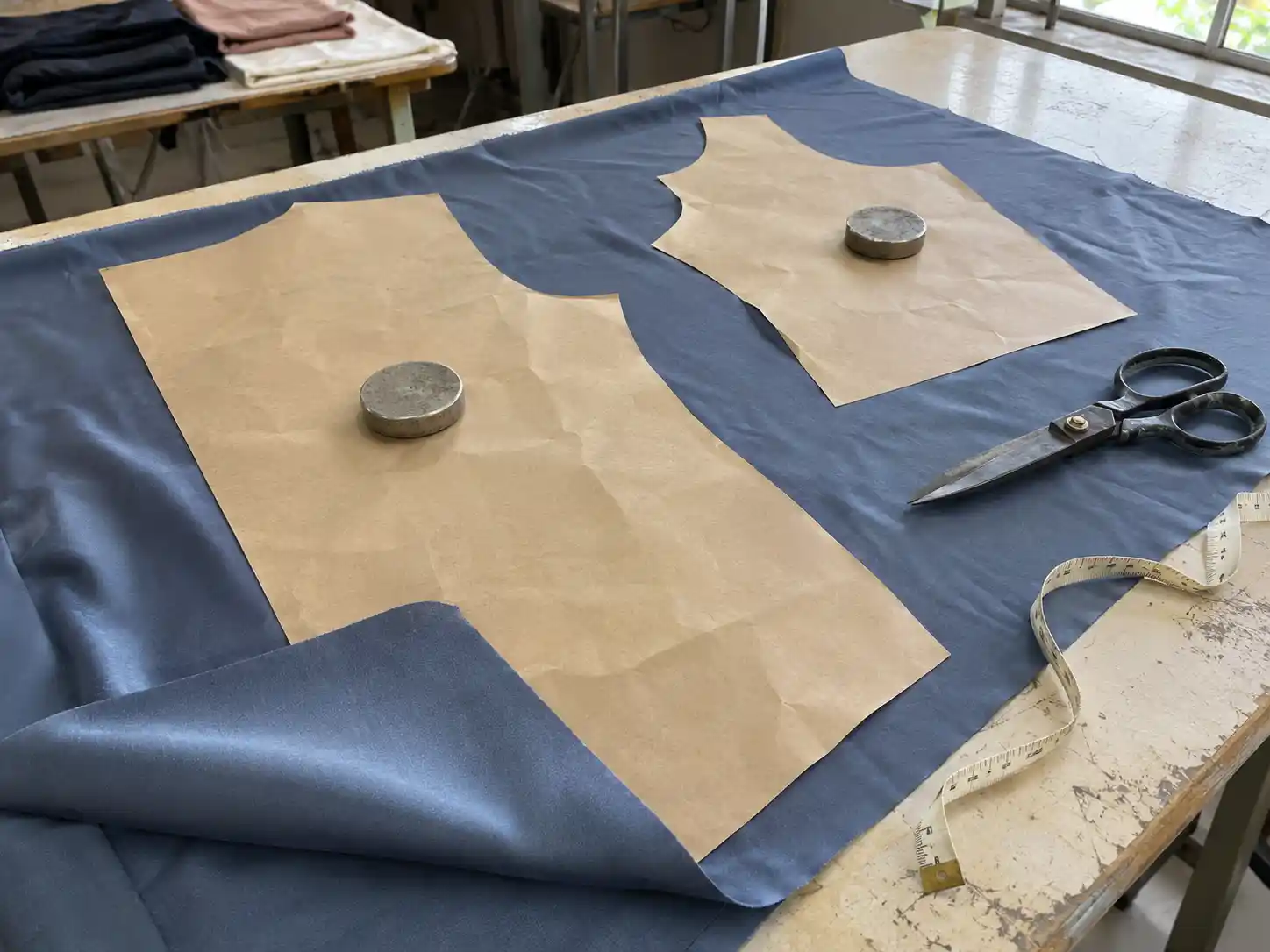
Fiber selection affects more than the appearance of the finished fabric. It can influence cutting stability, sewing settings, seam appearance, pressing, washing, fit, and final measurements. This is why XZapparel treats material development and garment manufacturing as connected activities rather than separate purchasing and production functions.
For example, a lightweight viscose woven fabric may provide beautiful drape but require careful handling during cutting. A stretch cellulosic knit may require different pattern allowances from a stable woven construction. A fabric with measurable shrinkage may require pre-production testing and pattern adjustment before bulk cutting.
XZapparel’s documented manufacturing structure includes six sample rooms, approximately 48 pattern makers, approximately 60 sample makers, more than 30 regular fabric suppliers, and approximately 80 sewing lines. The company profile also records monthly production capacity of approximately 180,000–200,000 pieces. These resources allow fabric decisions to be evaluated alongside pattern development, sampling, and manufacturing execution rather than after the design has already been locked.
The company’s planning benchmarks also provide a practical framework for collection development:
| Production stage | XZapparel planning baseline | Main objective |
|---|---|---|
| Simple first sample | 3–5 working days | Initial construction and fit |
| Complex first sample | 5–7 working days | Detailed construction and fit |
| Typical revisions | 2–3 working days | Correct fit and execution |
| Pre-production sample | 4–5 working days | Confirm final production standard |
| Bulk production | 25–35 working days | Manufacture approved production |
| Standard MOQ | 200 pcs/style/color | Subject to material and process requirements |
| Monthly production capacity | Approx. 180,000–200,000 pcs | Overall manufacturing capability |
These figures are planning baselines rather than fixed promises. Fabric availability, material development, approval speed, construction complexity, order quantity, and production scheduling can all affect the actual project timeline.
Which Sourcing and QC Factors Matter at Scale?
Once a garment moves into bulk production, the question changes from “Does this fabric look good?” to “Can the approved garment be reproduced consistently?” That distinction is particularly important with cellulosic fabrics because the final result depends on the interaction between fiber properties, fabric construction, cutting, sewing, washing, pressing, and finishing.
A structured quality process can include:
- Incoming material inspection: Check the fabric against approved specifications.
- Pre-production review: Confirm materials, measurements, construction, workmanship, and approved samples.
- Cutting inspection: Check cut panels and identify material-related problems early.
- Inline QC: Detect repeated sewing or construction defects during production.
- Measurement inspection: Compare garments against approved measurements.
- Finishing inspection: Review appearance, pressing, loose threads, stains, and workmanship.
- Final inspection: Assess finished garments against agreed quality standards.
- Packing inspection: Verify quantities, labels, folding, and packing requirements.
XZapparel’s documented quality system uses multiple inspection points rather than relying exclusively on the final inspection. Material-related checks can include fabric weight, shrinkage, washing behavior, colorfastness, pilling, stretch recovery, and other characteristics according to the garment.
The wider supply-chain environment is also changing. The European Commission identifies textile apparel as a priority category for Digital Product Passport requirements under the EU Ecodesign framework, with the textile-specific delegated act currently planned for Q4 2027. The exact requirements and implementation timeline remain subject to ongoing legislative and technical work.
For brands, this means material documentation should be treated as part of product development rather than as paperwork created after production. An organized garment file can connect the finished style with its composition, approved fabric, sourcing information, applicable certifications, testing, sample approvals, and quality requirements.
Conclusion
Cellulosic fiber trends for 2027 are not really about finding one material that replaces everything else. The more important shift is toward smarter material selection. Viscose will remain a major commercial workhorse because of its scale and versatility, while Lyocell and Modal are positioned to attract greater attention in comfort-led and premium womenswear. Recycled and next-generation cellulosics are moving toward wider commercial availability, but their current scale still requires careful evaluation. Textile-to-textile recycling remains a small proportion of total global fiber production, which makes realistic sourcing expectations particularly important.
At XZapparel, the practical value of these trends is found in translating material innovation into garments that can actually be sampled, fitted, tested, manufactured, inspected, and repeated. The company’s documented development structure includes six sample rooms, approximately 48 pattern makers, approximately 60 sample makers, more than 30 regular fabric suppliers, approximately 80 sewing lines, and a monthly production capacity of approximately 180,000–200,000 pieces. Its standard planning baseline also includes a 200-piece MOQ per style and color, with sampling and bulk-production timelines adjusted according to garment complexity and material readiness.
The strongest cellulosic choice for a 2027 collection may therefore be a proven viscose that gives a dress exactly the right movement, a Lyocell fabric that improves the feel of a blouse, a Modal knit that delivers reliable next-to-skin comfort, or a carefully engineered recycled-cellulose blend that creates a credible circular material story without sacrificing production practicality.
The real value of a material trend appears when it survives the entire product journey. It has to feel right on the body, perform after washing, make sense on the production floor, remain commercially available, and deliver the product quality that customers expect. That is where cellulosic fiber trends become more than a seasonal fashion story and become a meaningful direction for 2027 womenswear development.
What Is a Cellulosic Fiber?
Cellulosic fibers are fibers made primarily from cellulose, a natural polymer found in plant-based materials. In fashion, the term commonly includes regenerated fibers such as viscose, Lyocell, and Modal. These materials begin with cellulose feedstock and are processed into fibers through industrial regeneration processes. Their final characteristics depend not only on the fiber itself but also on yarn, fabric construction, finishing, and garment manufacturing.
Is Viscose Still a Trend in 2027?
Yes. Viscose is expected to remain highly relevant because it represents the largest share of MMCF production and can be developed into a wide range of woven and knitted fabrics. Its commercial strength comes from versatility rather than novelty. For womenswear, viscose remains particularly useful for dresses, blouses, skirts, relaxed trousers, and other garments where softness and fluid drape are important.
Is Lyocell Better Than Viscose?
Lyocell is not automatically better than viscose; the better choice depends on the garment. Lyocell can be attractive for products requiring a smooth hand, fluid drape, comfort, and a more premium material position, while viscose offers enormous commercial versatility and scale. XZapparel evaluates both according to fabric construction, GSM, washing behavior, dimensional stability, cost, availability, and the performance requirements of the finished garment.
Is Modal Good for Womenswear?
Modal can be particularly suitable for womenswear that prioritizes softness and next-to-skin comfort. It is commonly considered for lightweight knits, fitted tops, soft dresses, and relaxed casual garments. However, softness should not be confused with complete garment performance. Stretch recovery, pilling, shrinkage, dimensional stability, fabric construction, and finishing still need to be considered when developing Modal garments for commercial production.
Are Recycled Cellulosic Fibers Ready for Mass Fashion?
Recycled cellulosic fibers are progressing toward commercial use, but the market is still developing. Textile Exchange estimated that MMCFs made from recycled feedstocks represented approximately 1.1% of MMCF production in 2024, while textile-to-textile recycling across all fibers represented only about 0.76% of global fiber production in 2025. These figures show meaningful progress but also demonstrate that recycled cellulose should currently be evaluated according to actual supply availability rather than treated as a universal mass-market replacement.
What Should Brands Check When Sourcing Cellulosic Fabric?
Brands should check fiber composition, fabric GSM, construction, width, shrinkage, colorfastness, pilling, stretch and recovery where relevant, surface appearance after washing, material availability, MOQ, lead time, cost, and applicable certification or sourcing documentation. XZapparel also considers how the selected fabric behaves during cutting, sewing, pressing, finishing, and bulk production. The strongest sourcing decision is one that connects material performance with the actual requirements of the finished garment.