Skip to content

The most interesting fashion trends are not always the ones that completely replace an existing silhouette. Sometimes the stronger commercial idea is much quieter: a familiar dress gets an angled hem, a shirt loses its traditional center line, a skirt becomes shorter at the front and longer at the back, or one side of a garment carries more volume than the other. That is exactly what makes the asymmetric fashion trend 2027 worth watching. It is not simply a return of the one-shoulder dress. It is a broader movement toward controlled imbalance, fluidity, irregular proportion and garments that look different from conventional front-and-back symmetry.
For 2027, asymmetric fashion is best understood as a broader design direction rather than a single silhouette. SS27 runway evidence shows asymmetry appearing through uneven hems, handkerchief cuts, asymmetric dresses, skirts, tops, blouses and sleeves. The strongest signal is not that every garment will become asymmetric, but that designers are using controlled imbalance to make familiar womenswear feel more fluid, expressive and contemporary.
At XZapparel, this distinction matters because a runway idea only becomes commercially useful when it survives the journey from visual concept to pattern, fabric selection, sample, fit approval, production and final inspection. A dramatic asymmetric gown and an everyday asymmetric knit top may share the same visual language while requiring completely different technical decisions. After studying the SS27 evidence, the more useful question is not simply whether asymmetry is fashionable. It is where the trend is strongest, how much imbalance is appropriate, which fabrics support it, and how the idea can become a dependable finished garment.
Is Asymmetric Fashion a 2027 Trend?
Yes. Current SS27 runway evidence supports asymmetric fashion as a genuine 2027 womenswear direction, especially through uneven hems, asymmetric skirts and dresses, off-center construction and irregular draping. However, it is better understood as a flexible design language than as one dominant silhouette. Its commercial potential will depend on how effectively asymmetry is translated into comfortable, balanced, repeatable and manufacturable garments.
What Do the SS27 Runways Show?
The strongest signal is not one spectacular runway image but the number of different ways the same construction idea appears across collections. T-Fashion currently tracks asymmetric hem dresses, asymmetric hem skirts, asymmetric blouses and asymmetric sleeve dresses as separate SS27 key-item categories. Its broader SS27 index measures 146 key items, which places asymmetry inside a much larger pattern of silhouette and construction changes rather than treating it as an isolated editorial idea.
The quantitative evidence from London is particularly useful. T-Fashion reports asymmetric hem skirts in 111 looks from 38 designers, representing 7.7% of the 1,450 looks analyzed for London Fashion Week SS27 womenswear. The corresponding SS26 share was 3.3%, a rise of 4.4 percentage points. (Source: T-Fashion Runway Index, updated October 7, 2026.) That figure should not be interpreted as a forecast that 7.7% of retail skirts will be asymmetric. It is a runway measurement within a defined dataset, but it does provide stronger evidence than simply saying the trend “feels important.”
The geographic spread is also meaningful because the construction is not confined to one fashion week or one narrow product type. T-Fashion tracks asymmetric hem dresses and skirts across London, Paris, Milan and New York, while high-low hems also appeared in Copenhagen reporting. When an idea repeatedly appears across different fashion weeks and several garment categories, it becomes more reasonable to treat it as a seasonal design direction rather than a single designer’s experiment. For a manufacturer, that breadth matters because it creates several possible routes into the trend instead of forcing the entire collection toward one silhouette.
| SS27 runway indicator | Current measurement | What it tells us |
| London asymmetric hem skirts | 7.7% of analyzed looks | Significant runway visibility |
| London SS26 comparison | 3.3% | Lower previous-season share |
| Change | +4.4 percentage points | Clear increase in measured presence |
| Designers showing the trend | 38 | Broad participation |
| London looks with the trend | 111 | More than isolated examples |
| London womenswear looks analyzed | 1,450 | Defined measurement base |
Which Designers Are Using Asymmetry?
The designer evidence shows that asymmetry is not being expressed in one uniform way. Michael Kors used dress hems that moved from side to side, dipped between front and back, or extended into trailing elements. Tory Burch presented a coat dress with a deliberately tilted hem, while Marques’Almeida explored skewed proportions and tilted hems in occasionwear. These approaches are visually different, yet they all use imbalance to change the character of an otherwise recognizable garment.
Paris and Milan add further evidence. T-Fashion tracks asymmetric hem skirts in Paris across designers including Alaïa, Balenciaga, Sacai, Balmain and Valentino, while its Milan coverage includes examples from Prada, Blumarine and Jil Sander. In New York, asymmetric hem dresses and skirts were also tracked as SS27 key items. The significance is not that every major fashion house has adopted exactly the same silhouette. The significance is that the construction principle is flexible enough to appear within very different design identities.
Dior offers an especially interesting interpretation because asymmetry becomes part of a larger idea of natural irregularity. Jonathan Anderson’s SS27 collection used uneven hemlines, mismatched elements and raw edges, with Reuters reporting that the collection drew inspiration from the naturally asymmetric form of Chinese wenwan walnuts. This gives the trend a more conceptual foundation: imbalance can communicate organic character and individuality rather than simply functioning as a visual trick.
For XZapparel, the practical lesson is that a product brief saying “make it asymmetric” is incomplete. The development team still needs to know whether the asymmetry belongs in the hem, neckline, sleeve, panel, closure, drape or overall proportion. Each choice can change fabric consumption, pattern construction, sewing sequence, grading requirements and quality-control priorities, so the visual instruction needs to be translated into a specific technical construction before a sample can be judged fairly.
How Strong Is the Trend Signal?
The evidence is strong enough to treat asymmetry as a credible SS27 direction, but not strong enough to claim that it will become one of the largest universal commercial trends of 2027. The London skirt data shows a clear increase, while the appearance of related constructions across several cities provides breadth. At the same time, runway frequency measures fashion visibility rather than retail sell-through, consumer demand, margin or reorder performance.
That distinction is important for a manufacturer because trend forecasting becomes less useful when every runway signal is treated as a guaranteed sales opportunity. A dramatic asymmetric evening dress may be highly visible in fashion coverage but have a narrow customer base. A subtle asymmetric blouse or midi skirt may receive less editorial attention yet have a stronger chance of becoming a repeat commercial product.
At XZapparel, the more reliable approach is to treat runway evidence as the beginning of product evaluation rather than the final answer. A trend becomes commercially interesting when the construction works with the intended fabric, target price, size range, comfort requirements and production method. The runway can tell us that asymmetry deserves attention, but sampling, fitting and technical review determine which version deserves investment and which version should remain an editorial reference.

What Will Asymmetric Fashion Look Like in 2027?
The asymmetric fashion trend 2027 is moving beyond the familiar one-shoulder dress toward controlled irregularity. Diagonal hems, handkerchief shapes, uneven layers, shifted panels, asymmetric sleeves, off-center closures and fluid draping can all create the effect. The garment remains recognizable, but its balance is deliberately changed to create movement and individuality across different levels of fashion intensity.
Which Hemlines Are Emerging?
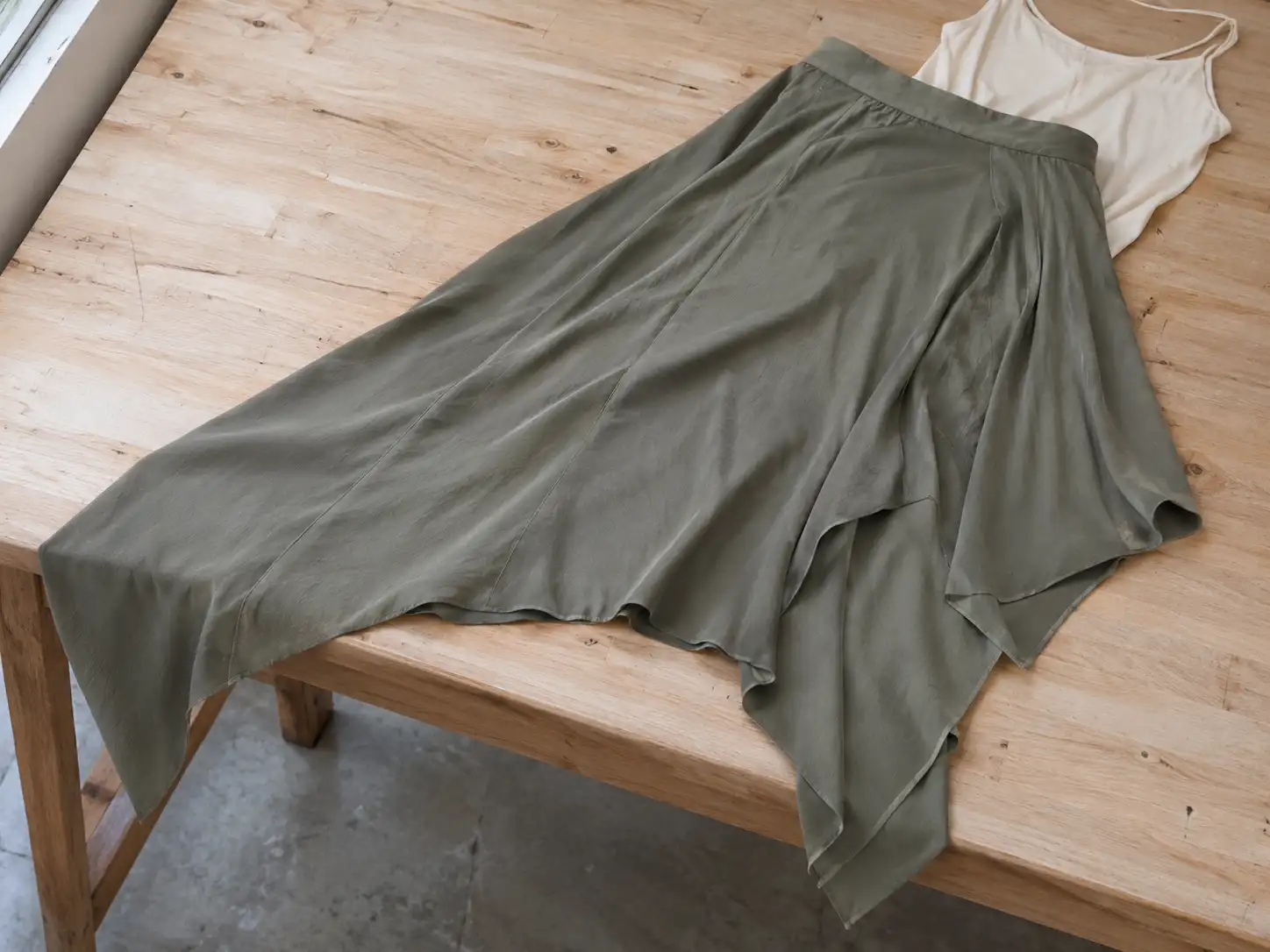
The hem is one of the clearest entry points because it can transform a familiar dress or skirt without rebuilding the entire silhouette. SS27 examples include high-low proportions, handkerchief hems, shorter-front/longer-back shapes, diagonal edges and irregular panels. T-Fashion’s Milan coverage notes short-front, longer-back skirt proportions at Sportmax, while other collections used hanging material and uneven mini-skirt constructions that became softer in motion.
This approach has a practical advantage: the customer can still understand the product immediately. It remains a dress or skirt first, with the irregular hem providing the seasonal fashion statement. The amount of asymmetry can also be adjusted according to the target market. A small side drop may work for an everyday collection, while a dramatic handkerchief shape can support occasionwear.
The technical issue is that a hem must be evaluated on the body as well as on a flat table. Fabric drape, grain direction, seam tension, pressing and dimensional stability all influence the final appearance. A difference of only a few centimeters may look restrained on a sketch but become much more noticeable when the wearer walks. For that reason, asymmetric hems should be tested in motion before the pattern is considered final.
How Are Necklines and Sleeves Changing?
One-shoulder dressing remains part of the asymmetric vocabulary, but the 2027 interpretation is broader. Asymmetry can appear through a neckline crossing diagonally over the body, one exposed shoulder, sleeves with different lengths or volumes, an offset shoulder seam, or a neckline combined with a one-sided drape. T-Fashion separately tracks asymmetric sleeve dresses among SS27 key items, showing that sleeve imbalance is being treated as a distinct construction direction rather than merely a variation of one-shoulder dressing.
This is particularly useful for tops and dresses because a relatively small pattern change can create a significant visual difference. A basic jersey dress can become more directional through one asymmetric sleeve, while a woven blouse can gain a stronger identity through an off-center neckline or shoulder seam. These details can create newness without changing the entire body shape, which gives product teams more freedom to work within established blocks, existing fit standards and familiar customer expectations.
Comfort and stability become more important as the construction becomes more asymmetric. A one-shoulder neckline must remain secure during movement, while different sleeve weights can create uneven tension across the body. Elastic, binding, facing, seam reinforcement or internal support may be required. The finished garment should feel effortless to the wearer even though the internal engineering has been carefully considered.
What Role Does Draping Play?
Draping is one of the most natural ways to express asymmetry because fabric responds directly to gravity, movement and the body. Instead of cutting a strong diagonal line into the garment, designers can allow a panel, scarf-like extension, gathered section or folded layer to travel down one side. Dior’s SS27 collection used uneven hemlines, mismatched elements and raw edges as part of a broader exploration of irregularity and instinctive dressing.
The commercial appeal is clear because an asymmetric panel can make a simple dress appear more sophisticated without relying on heavy embellishment. A side gather can change the visual shape of a jersey top, while a lightweight overlay can introduce movement without rebuilding the entire base garment. These details can connect runway experimentation with more accessible products, especially when the asymmetry is concentrated in one area and the remainder of the garment stays familiar enough for everyday styling.
The difficulty is controlling something that is designed to appear uncontrolled. Every draped element still needs a stable attachment point, predictable fabric behavior and a repeatable sewing method. If the gathering is too loose, the design can collapse. If it is too tight, movement and comfort suffer. The strongest asymmetric draping looks spontaneous on the outside because the technical decisions underneath are precise.
Which Garment Categories Lead the Trend?
Dresses and skirts currently provide the clearest asymmetric runway signals, but the direction is spreading into tops, blouses and sleeves. SS27 tracking identifies several asymmetric categories across fashion weeks, making the idea more useful as a cross-category design language than as a single “asymmetric dress” trend. For XZapparel, that breadth allows one seasonal idea to be translated into different product families while keeping the collection visually connected.
Are Asymmetric Dresses Growing?
Asymmetric dresses are among the most visible expressions of the trend because the dress provides a large continuous surface for changing proportion. SS27 examples include uneven hems, one-sided draping, tilted shapes and panels extending beyond the main silhouette. T-Fashion tracks asymmetric hem dresses as one of its 146 SS27 key items and records the category across Paris, Milan, New York, London and Copenhagen.
The commercial opportunity is strongest when the asymmetric element works with a familiar dress foundation. A column dress can receive a diagonal hem, a midi dress can gain a longer side panel, a shirt dress can use a high-low hem, and a jersey dress can introduce a side gather. These versions allow a collection to capture the trend without making the garment difficult to understand or style.
Proportion is the critical development issue. An asymmetric difference that looks elegant on one body length may appear awkward on another, especially when the garment is graded through a full size range. The pattern therefore needs to preserve the intended visual relationship between the short and long sides rather than simply applying standard grading rules independently to each section. A successful size range should still look intentionally asymmetric at every key size, because the eye reads the relationship between the two sides before it notices individual measurement values.
For XZapparel, this is where product development becomes more than sewing. Pattern making, fabric selection, sample fitting, revision and production planning need to be connected from the first sample. The objective is to preserve the designer’s intended balance after the style has been graded and manufactured, because a construction that works on one sample can behave differently once the fabric changes, the size range expands or production quantities increase.
Which Skirts Stand Out?
Skirts currently provide one of the strongest measurable signals. T-Fashion’s London SS27 data shows asymmetric hem skirts in 111 looks from 38 designers, representing 7.7% of 1,450 analyzed looks, compared with 3.3% in SS26. (Source: T-Fashion Runway Index, updated October 7, 2026.) Paris, Milan and New York tracking also identifies asymmetric hem skirts as part of the SS27 landscape. This is useful evidence of runway momentum, but it remains a runway metric rather than a retail sales forecast; the distinction is important when deciding how much production exposure a trend deserves.
The most relevant forms include handkerchief hems, high-low lengths, diagonal hems and uneven panels. Sportmax used different front and back lengths, while Tod’s introduced free-hanging squares of cloth or leather that created uneven mini-skirt shapes. These are technically different solutions to the same visual problem: how to make a familiar skirt feel less regular. The commercial decision is to select the construction that adds enough movement or distinction without introducing unnecessary fabric waste, difficult sewing operations or fit problems.
| Asymmetric skirt direction | Typical complexity | Main development concern |
| Simple angled hem | Low–moderate | Accurate hem geometry |
| Front/back high-low | Moderate | Movement and side profile |
| Handkerchief hem | Moderate–high | Grain and multiple hem points |
| Layered uneven panels | High | Added weight and seam control |
| Hanging extensions | High | Attachment strength |
| Multi-panel sculptural shape | High | Pattern efficiency and grading |
The advantage of skirts is flexibility. A relatively simple asymmetric hem can introduce the trend at an accessible level, while a more elaborate layered construction can support a higher-fashion collection. This gives brands room to build a product range around the same seasonal direction rather than placing all of the risk into one extreme style. XZapparel can therefore evaluate asymmetry as a spectrum of construction choices, allowing a collection to include both lower-complexity commercial pieces and more directional statement styles.
How Are Tops and Blouses Evolving?
Tops and blouses may become one of the most practical ways to commercialize asymmetry because they can add a fashion point while remaining easy to coordinate with trousers, denim and skirts. T-Fashion identifies asymmetric blouses as an SS27 key item and tracks examples across London, New York and Milan. The category includes different interpretations, from off-center construction to uneven hems and asymmetric sleeves.
The most accessible versions tend to focus on one clear feature. An uneven lower edge can transform a basic top without changing its neckline. An offset button placket can create a directional look while retaining the recognizable structure of a shirt. A side-gathered panel can add softness to jersey. An asymmetric sleeve can create visual interest without requiring a completely new body block.
These details also illustrate an important relationship between fashion and cost. An asymmetric garment does not automatically consume much more fabric, but complexity can rise through additional pattern pieces, difficult seam matching, specialized finishing or slower sewing operations. The correct assessment therefore focuses on construction rather than appearance alone, because two garments can look similarly asymmetric while requiring very different amounts of pattern work, sewing time and quality-control attention.
At XZapparel, a practical product-development review asks whether the asymmetric feature remains stable across sizes, colors and production quantities. A garment that looks excellent in one sample but loses its intended proportion during grading or bulk sewing is not a successful commercial interpretation. Good development protects the original idea while making it repeatable, measurable and realistic for the production environment in which the final garment will actually be made.

How Is 2027 Asymmetry Different?
The key change is that 2027 asymmetry is less dependent on dramatic one-shoulder silhouettes and more focused on controlled irregularity. Designers are using uneven hems, raw edges, shifted proportions, draping, mismatched elements and layered construction to make familiar garments feel less rigid. The result is often softer and more natural than the highly graphic versions associated with earlier asymmetric cycles.
What Has Changed From Previous Seasons?
Asymmetry itself is not new. One-shoulder dresses, high-low skirts, diagonal necklines and deconstructed tailoring have repeatedly returned to fashion. What changes in SS27 is the way several of these techniques are being connected to a wider interest in individuality, irregularity and less rigid construction. Instead of one recognizable asymmetric trick dominating the look, several small shifts can work together to make the garment feel less formal and more instinctive.
Dior is an especially useful example because asymmetry becomes part of the overall attitude of the garment. Uneven hemlines, mismatched elements and raw edges make the collection feel intentionally imperfect rather than simply “asymmetric.” Tory Burch used tilted hems and dresses that appeared to be coming undone, while Michael Kors explored hems that zigzagged, dipped or extended into trailing shapes.
This suggests that the more durable part of the trend may be the design principle rather than any single silhouette. A brand does not need to reproduce a particular runway dress to participate in the direction. It can interpret the same idea through a skirt, blouse, lightweight dress or layered top that fits its existing customer, existing fit blocks and established styling language. This is often a safer way to capture a trend because it preserves product familiarity while still introducing a visible seasonal change.
For XZapparel, this is an important distinction when reviewing a trend board. Copying a runway image can create a visually recognizable sample, but understanding the underlying construction allows the same fashion direction to be adapted into several commercial products. That creates more flexibility and reduces dependence on a single high-risk silhouette, while also giving the development team a clearer basis for discussing fabric choice, pattern balance, sewing sequence and target cost before the sample is finalized.
How Are Soft and Sharp Forms Blended?
SS27 asymmetry is particularly interesting because precise geometry and soft movement are often working together. A sharp diagonal hem can be cut in a stable woven fabric while a fluid panel falls away from the same seam. A structured bodice can release into draped fabric, while a crisp blouse can have one side extended into a softer irregular layer. The contrast gives the garment energy without requiring large amounts of decoration, and it allows the same construction principle to move between refined, romantic and more architectural aesthetics.
The contrast creates visual tension without requiring excessive decoration. Fabric determines whether the same asymmetric line feels architectural, romantic, relaxed or dramatic. A firm material emphasizes geometry, a fluid material emphasizes movement, and a stretch fabric can bring the asymmetry closer to the body. A lightweight woven fabric can let the feature float away from the body, making the final effect softer and more dynamic. The design therefore cannot be separated from the material that carries it.
The wider SS27 season is also strongly associated with lightness and movement. Vogue’s season overview highlights breezy and lightweight approaches, while Wallpaper* identifies ultra-lightweight clothing as one of the major seasonal directions. That environment naturally supports asymmetric constructions because irregular hems and draped panels can create movement without adding substantial visual or physical weight. For spring and summer product development, this combination can be especially effective when the fabric is light enough to move but stable enough to retain the intended construction after care.
At XZapparel, fabric testing is therefore inseparable from silhouette development. Drape, GSM, shrinkage, colorfastness, washing behavior, stretch and recovery, pilling and dimensional stability can all affect whether the final garment retains its intended asymmetry. The pattern cannot be considered finished until the material has demonstrated that it can support the design, because the final silhouette is a combined result of geometry and fabric behavior rather than the pattern alone.
Is Asymmetry Becoming More Wearable?
There are signs that the trend is moving toward greater wearability rather than remaining exclusively conceptual. Copenhagen SS27 reporting identified high-low hems across tops, dresses and skirts, while current runway coverage also points to small irregular details such as mismatched buttons as accessible ways to update familiar garments. These examples show that asymmetry does not always require a dramatic evening silhouette.
Wearability does not mean eliminating complexity. A simple-looking asymmetric garment may still need careful internal construction. A one-shoulder top needs neckline stability, a diagonal hem needs controlled length relationships, a side drape needs secure anchoring, and a long back panel needs to move without twisting the rest of the garment. The customer should experience the garment as comfortable and effortless even though the development team has solved several technical problems behind the scenes.
The commercially strongest approach is often to make one asymmetric element the visual focus and keep the rest of the garment relatively calm. That gives the wearer a clear reason to choose the product without forcing the entire silhouette to become unconventional. It also makes styling easier, because the asymmetric feature becomes a recognizable design signature rather than one of several competing details that restrict how the garment can be worn.
This also makes the trend easier to scale across a collection. A subtle asymmetric top can sit beside a stronger asymmetric dress, while both communicate the same seasonal direction. The result is a collection that feels coherent without making every product look like the same garment with a different hem. From a development perspective, this approach also allows the team to reuse successful pattern principles while adjusting fabric, length, sleeve treatment or degree of draping for different product roles.
Which Fabrics and Details Suit Asymmetric Design?
The right fabric depends on the intended asymmetric effect. Fluid materials support draping and movement, stable fabrics preserve crisp geometric lines, and stretch materials can support body-following shapes. The critical factors are drape, weight, recovery, shrinkage, seam behavior and dimensional stability. A fabric is suitable only when its physical behavior supports the intended shape through fitting, production and normal care.
Which Fabrics Create Better Movement?
Fluid fabrics are naturally attractive for asymmetric products because gravity helps create the intended imbalance. Soft woven fabrics, viscose-based qualities, lightweight crepes, satin-like surfaces, chiffon, organza and selected jersey constructions can all create different results. None is universally better; the correct choice depends on whether the designer wants the asymmetry to float, cling, hold a sharp edge or move dramatically.
A flowing asymmetric dress needs enough drape for a longer panel to fall naturally, while a sharply angled skirt needs sufficient stability to keep its geometry visible. Stretch jersey can be excellent for an asymmetric fitted top but may be unsuitable for a structured handkerchief skirt if recovery pulls the hem upward. These differences are easy to overlook when a fabric is selected from a swatch, which is why the final decision should be based on the material’s behavior within the actual garment construction.
This is why fabric should be tested on the actual pattern. A swatch can communicate hand feel and surface appearance, but it cannot show exactly how an asymmetric hem will behave around the body. Sampling should examine movement, seam tension, pressing, washing response and recovery before the fabric is locked for bulk production. For XZapparel, this testing stage is particularly valuable because it can reveal whether a visually attractive fabric will remain stable enough for the specific asymmetric construction.
For XZapparel, the development process benefits from access to a broad sourcing network and from testing material performance before final approval. The company’s established workflow includes fabric inspection and testing for properties such as shrinkage, colorfastness, washing behavior, pilling, stretch and recovery, spirality and dimensional stability. These checks are especially relevant when a product’s visual identity depends on unequal lengths or carefully controlled drape.
How Do Construction Details Shape the Silhouette?
Asymmetry is unusually sensitive to construction because the eye quickly notices when imbalance appears accidental. A twisted side seam, uneven tension or unstable shoulder can make the garment look defective rather than deliberately irregular. Construction details such as reinforcement, internal binding, facing, elastic stabilization, strategic gathers and concealed support can therefore be part of the design rather than invisible afterthoughts.
Pattern development is equally important. The team needs to consider grain direction, seam placement, body balance, fabric weight and size grading from the beginning. An asymmetric pattern cannot always be created by taking a symmetrical block and simply shortening one side. Changing one area can alter how the entire garment hangs, especially when the design includes diagonal seams, one-sided draping or a panel that carries additional weight.
For example, moving a shoulder seam may change neckline tension, extending one hem can influence the angle of the side seam, adding a heavy draped panel can pull the garment downward, and gathering one side can change the apparent waist position. These effects need to be tested rather than assumed because the final garment is a three-dimensional object in motion, not simply a collection of measurements on a flat technical drawing.
Sampling provides the opportunity to correct such problems before production. Fit, movement, sewing sequence, seam strength and finishing can all be reviewed at this stage. A successful asymmetric product should look distinctive from the outside while remaining disciplined underneath. That combination is what allows a fashion idea to survive repeated production, because the final objective is not merely to approve one attractive sample but to establish a construction that can be reproduced with controlled proportions.
Which Finishes Support the Look?
Finishing should reinforce the character of the asymmetric garment. A narrow clean hem can preserve the lightness of a flowing dress, while a more structured woven skirt may require a different hem treatment to maintain shape. Raw edges can communicate deliberate imperfection, but they must be appropriate to the fabric, target price and expected product life. Finishing should therefore be selected as part of the design solution rather than added after the main construction has already been decided.
Consistency becomes especially important when the same style is produced in several sizes and colors. Customers can compare two sides of an asymmetric hem immediately, so differences caused by inconsistent sewing, pressing or measurement are much more visible than they might be on a conventional straight hem. The more distinctive the asymmetry, the more carefully the critical measurements and visual relationships need to be controlled during bulk production.
A useful quality process therefore checks more than a final measurement sheet. Fabric behavior, dimensional stability, seam appearance, pressing and washing performance can all influence the final silhouette. For an asymmetric garment, critical measurements should be checked in relation to one another rather than treated as isolated numbers, because the visual effect depends on the relationship between the two sides rather than on any single measurement alone.
XZapparel’s documented quality process includes fabric inspection, pre-production review, cutting inspection, inline QC, measurement, 100% finishing inspection, final inspection and packing inspection. This eight-stage structure is particularly relevant to asymmetric products because the design depends on proportions remaining controlled from the approved sample through bulk production. When a hem, panel or neckline is deliberately uneven, the quality process has to distinguish intended irregularity from unintended variation.
Are Asymmetric Styles Commercially Relevant?
Yes, but commercial relevance depends on the level and location of asymmetry for the garment, customer and price position. The strongest opportunity is often a recognizable product with one clear asymmetric detail that remains comfortable, repeatable, size-consistent and practical to manufacture. For XZapparel, the commercial test is whether the trend adds value without creating technical complexity the customer cannot see or appreciate.
Which Styles Are Most Versatile?
Versatility usually increases when asymmetry has one clear focal point. An asymmetric hem on a midi dress, a diagonal panel on a blouse or a high-low skirt can provide noticeable fashion value while leaving the rest of the product easy to understand and style. By contrast, combining an irregular neckline, asymmetric sleeve, multiple diagonal panels and a highly uneven hem can create a powerful editorial image but a narrower everyday product.
A useful way to structure a collection is to work with different levels of visual intensity. This makes it possible to use the same 2027 direction across different product roles rather than expecting every style to carry the same degree of visual drama. A commercial collection can therefore combine relatively quiet asymmetric pieces with a smaller number of statement garments, giving customers multiple ways to engage with the trend.
- Subtle: a shifted seam, angled hem or small side detail.
- Moderate: an asymmetric neckline, draped panel or handkerchief hem.
- Statement: major proportion changes, multiple irregular panels or sculptural construction.
This does not mean subtle styles are always more commercial. Occasionwear may support stronger asymmetry, while casualwear may benefit from a quieter intervention. The important question is whether the level of asymmetry matches the customer and the role of the garment, because a dramatic silhouette can be appropriate when the product is designed for events while the same construction may be impractical for an everyday wardrobe.
For a collection, this approach also makes it possible to build a product family around one construction idea. A stronger asymmetric dress can establish the seasonal statement, while a simplified skirt and top carry the same design language into products that are easier to wear and potentially easier to produce. This gives the collection a recognizable visual thread while allowing different products to occupy different price, styling and complexity positions.
How Does Asymmetry Affect Product Development?
Asymmetry can affect pattern efficiency, fabric consumption, sewing operations, grading, finishing and quality control. A simple angled hem may require a relatively contained pattern modification, while a layered handkerchief dress with several bias-cut panels can introduce substantially more technical work. The visual appearance of complexity is therefore not a reliable measure of actual manufacturing complexity, and the production assessment should be based on the actual pattern pieces, fabric behavior, sewing sequence and finishing requirements.
Fabric consumption can increase because irregular panels may nest differently during cutting. Additional seams can increase sewing time, while diagonal or curved seams may require more careful matching. Uneven hems demand tighter measurement control, and draped sections may require special handling during assembly. None of these factors automatically makes an asymmetric garment commercially unattractive, but they should be understood before costing and production quantities are finalized.
An experienced development team evaluates these factors before a design is treated as production-ready. The questions are practical: can the fabric support the intended shape, can the pattern be graded without losing the visual relationship, can the sewing sequence maintain the drape, can the finished garment survive washing and repeated wear, and can quality inspectors measure the critical points consistently? Answering those questions early is usually more efficient than discovering a construction problem after bulk production has started.
XZapparel’s manufacturing system is designed to connect pattern development, sourcing, sampling, production and quality control rather than treating them as separate activities. Its documented planning references include a standard MOQ of 200 pieces per style and color, sample development of around 3–5 working days for simple samples and 5–7 working days for complex samples, with revisions generally planned at 2–3 working days and PPS around 4–5 working days. Bulk production is typically planned at 25–35 working days once materials are ready, the PPS is approved and production details are confirmed. These figures are planning references, not unconditional delivery guarantees.
What Should Brands Watch Next?
The next question is whether asymmetry continues moving from runway visibility into a broader range of commercially useful products. Current evidence is encouraging because the design language already appears across dresses, skirts, tops, blouses and sleeves. London provides a clear quantitative signal for asymmetric hem skirts, while Paris, Milan, New York and Copenhagen provide broader category evidence. The next stage is to see whether these constructions maintain customer appeal when they move from runway presentation into actual wardrobes and commercial collections.
The most useful indicators to monitor are not simply the number of runway photographs. They include the breadth of categories, recurrence across fashion weeks, designer participation, construction simplicity, customer response, fabric cost and the ability to translate the design into different price levels. A trend that remains visually interesting but proves difficult to fit, cost or reproduce may have limited commercial value, while a quieter construction that performs well across several categories can become much more useful.
| Trend signal | Current SS27 evidence | Commercial question |
| Asymmetric hem skirts | 7.7% of London analyzed looks | Can the shape move beyond runway styling? |
| Designer participation | 38 London designers | Is adoption broad enough to persist? |
| Asymmetric hem dresses | Tracked across multiple fashion weeks | Can the direction scale across categories? |
| Asymmetric blouses | Tracked in several SS27 cities | Can everyday products absorb the detail? |
| Asymmetric sleeves | Separate SS27 key-item category | Can comfort and stability be maintained? |
| High-low hems | Seen across tops, dresses and skirts | Which constructions offer the best balance? |
The strongest strategy is not to assume that every asymmetric runway look deserves production. Instead, a brand can evaluate a controlled range of constructions against its customer, price point and product category. A commercial dress may need only a modest hem shift. An occasionwear style may justify a longer asymmetric train. A blouse may benefit more from an offset panel than from a completely asymmetric body.
This is where XZapparel’s product-development role becomes useful. A trend concept can be assessed as a real garment, with fabric behavior, pattern balance, sample fitting, sewing construction, quality requirements and production planning considered before a final bulk decision is made. The objective is not to make the sketch look fashionable. It is to make the fashion idea work consistently as a finished product.
The asymmetric fashion trend 2027 is a credible SS27 direction, but its value lies less in the simple return of one-shoulder dressing and more in the wider acceptance of controlled irregularity. Uneven hems, asymmetric skirts and dresses, shifted panels, off-center construction, asymmetric sleeves and fluid draping are appearing across multiple fashion-week environments. The strongest measurable example is London, where asymmetric hem skirts reached 7.7% of analyzed looks, up from 3.3% in SS26. (Source: T-Fashion Runway Index, updated October 7, 2026.)
For brands, however, runway visibility is only the first layer of the decision. A useful commercial style has to perform on the body, work with the selected fabric, maintain its proportions through grading, survive normal care and remain consistent when produced repeatedly. That is why experienced product development matters so much with asymmetric fashion. A beautiful sketch can become a difficult garment if the design ignores grain, fabric recovery, seam balance or finishing.
At XZapparel, the most productive way to approach this trend is to separate the fashion idea from the specific runway image. The team can look at the underlying construction—angled hem, side drape, shifted neckline, asymmetric sleeve or irregular panel—and determine how it could work within the intended product category. This creates more room for practical interpretation and helps brands avoid investing too heavily in a silhouette simply because it attracted attention on the runway. The result is a clearer path from trend research to fabric selection, pattern development, sampling and production.
The 2027 opportunity is therefore not “more asymmetry at any cost.” It is better described as smarter asymmetry: enough imbalance to make a garment distinctive, enough structure to make it dependable, and enough restraint to allow the customer to actually wear it. For XZapparel, that balance is where runway direction becomes product value, because the strongest fashion idea is ultimately the one that remains convincing after fitting, production, washing, styling and repeated wear.
Is asymmetric fashion a trend for 2027?
Yes. SS27 runway evidence supports asymmetry as a meaningful 2027 womenswear direction, especially through asymmetric hems, skirts, dresses, blouses, sleeves and draped construction. T-Fashion measured asymmetric hem skirts in 7.7% of London SS27 womenswear looks, up from 3.3% in SS26. However, runway frequency should be treated as trend evidence rather than a direct forecast of retail sales. The commercial opportunity varies by category, customer, fabric and degree of asymmetry.
What are the biggest asymmetric fashion trends for 2027?
The most visible directions include diagonal and high-low hems, handkerchief skirts, asymmetric dresses, one-shoulder or offset necklines, asymmetric sleeves, uneven layers and one-sided draping. The broader change is that asymmetry is becoming less dependent on one specific silhouette. Designers are using irregular proportions across several garment categories, allowing the same design principle to move from occasionwear into more accessible dresses, skirts, tops and blouses.
Are asymmetric dresses still fashionable in 2027?
Yes. Asymmetric hem dresses remain part of the SS27 runway landscape across multiple fashion weeks. The most commercially flexible versions retain a familiar base shape and use one strong asymmetric feature, such as a diagonal hem, side drape or longer panel. This makes the product easier to style and generally easier to understand than a dress in which several different asymmetric elements compete for attention.
Which fabrics are best for asymmetric dresses and skirts?
There is no single best fabric because the choice depends on the intended effect. Fluid fabrics are useful when the design depends on draping and movement, while more stable fabrics are better for crisp geometric hems and structured panels. Stretch fabrics can work well for body-following asymmetric tops. Before bulk production, the actual fabric should be tested with the actual asymmetric pattern because drape, shrinkage, recovery and seam behavior can materially change the finished silhouette.
Are asymmetric skirts commercially wearable?
Yes, particularly when the asymmetry is controlled. London SS27 runway data provides a strong seasonal signal, with asymmetric hem skirts appearing in 7.7% of analyzed looks. Commercially, simpler angled hems, high-low proportions and carefully controlled handkerchief shapes can be more versatile than extremely sculptural constructions. The right choice depends on the customer’s styling habits, the intended price position and how much visual novelty the collection needs.
How difficult are asymmetric garments to manufacture?
Difficulty varies significantly by construction. A simple asymmetric hem can be relatively straightforward, while a multi-panel handkerchief dress with draping, bias-cut sections and additional layers can require considerably more development and sewing control. Pattern grading, fabric consumption, seam matching, stabilization and quality inspection all need attention. XZapparel evaluates these factors during development and sampling so that the final construction is suitable for repeat production.
Can XZapparel develop custom asymmetric womenswear?
Yes. XZapparel’s product-development workflow can support asymmetric dresses, skirts, tops, blouses and related womenswear constructions from design interpretation and fabric sourcing through pattern development, sampling, revisions, production and quality control. The most useful starting point is a clear product brief covering the intended silhouette, asymmetric feature, fabric direction, target market, quantity and delivery requirements. This allows the technical team to assess the design before it moves into bulk production.